

During international recording sessions, one remark appears surprisingly often.
“French sounds very fast.”
The comment usually comes from producers hearing the language closely for the first time. When a language feels unfamiliar, every sentence can seem to move more quickly than expected.
A few minutes later, something interesting happens. Once the rhythm settles and the intention becomes clear, the same producers who initially thought the language sounded fast start hearing something else instead: the musicality of French.
Moments like this happen regularly during international productions. They reveal something important about recording in another language. Choosing the right French voice over is not only about the sound of a voice. It is also about working with someone who understands how the language naturally flows within a project.
French is used across several markets, each with their own expectations and nuances. I explored this in more detail in a previous article about where you can use a French European voiceover.
The first take often sets the tone
In many sessions, the first take plays a special role.
Before recording begins, the team usually exchanges a few words while connecting everyone to the session. Sometimes the conversation is brief. Occasionally the atmosphere feels almost silent, which can be surprisingly unusual in a creative environment.
Then comes the first take.
More often than not, that moment reassures everyone in the room. The producer hears how the language sits naturally in the script, the engineer confirms the recording chain is clean, and the session quickly finds its rhythm.
From that point on, the focus shifts to details rather than uncertainty.
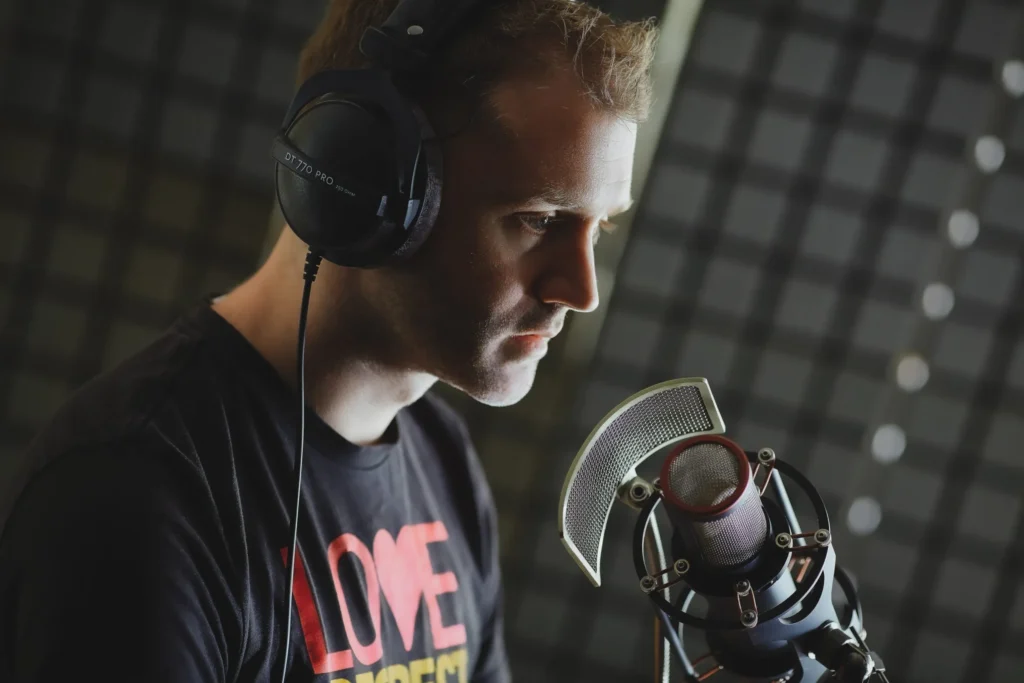
When small linguistic choices matter
International productions frequently involve translated scripts. Most of them arrive well prepared.
Completely unusable translations are rare. What appears more often are small details: a word that feels slightly too literal, or a sentence structure that resembles written translation more than spoken French.
These situations usually require subtle adjustments rather than major changes. A different word choice or a slightly rebalanced sentence can often restore the natural rhythm of the language while preserving the original meaning.
For more structured formats such as animated content or corporate storytelling, I also shared a practical guide on French voiceover for explainer videos.
During sessions, another frequent topic involves acronyms.
In French, some acronyms are pronounced letter by letter, while others naturally become a word. Recording both options often provides the production team with useful flexibility.
These moments rarely take long. They simply reflect the collaborative nature of international recording sessions.
Preparation before the session begins
Much of the work happens before the recording even starts.
Whenever possible, I review the script in advance. This preparation allows potential questions to appear early: a brand name that may require confirmation, an acronym with multiple possible pronunciations, or a sentence that benefits from a slightly more natural phrasing.
Clarifying these points before the session helps everything move smoothly once producers, engineers and clients are connected.
And whenever a translation works particularly well, I make a point of mentioning it. It also allows the studio or the agency to identify translation partners they can rely on for future projects.
Different studios, different working cultures
Working with international studios also means discovering different professional cultures.
German sound engineers, for example, often bring remarkable precision to the recording process. Takes are carefully numbered, instructions remain clear, and recording patterns such as “three in a row” frequently provide several options for the production team.
That level of organisation creates a comfortable environment where both efficiency and creativity can coexist.
Over time, these shared working habits build trust.
During a recent session with a studio I regularly collaborate with, the sound engineer connected the client to the call and introduced the recording very simply:
“Today we’re recording with François, so the session should go quickly.”
Hearing that kind of confidence always feels reassuring — and it also reflects the trust that develops through consistent collaboration.
When the artistic dimension appears
Even with a well-prepared script, creative choices often emerge during the recording itself.
During one session with the same German team, we finished recording the first section of a film and listened back together. After hearing the take, I suggested something to the engineer.
“I think the energy in that first section can go further. Let’s record it again.”
We still had time scheduled for the session, so we recorded a new version. These moments are part of what makes voice over work both technical and artistic at the same time.
Everyone in the room shares the same objective: delivering the strongest version of the project.
Technical reliability still matters
Alongside the artistic and linguistic aspects of a recording session, technical reliability remains essential.
During a live recording for an audioguide produced in Switzerland, the client greeted me on the call and immediately commented on the sound quality.
“Your noise floor is excellent,” he said.
He then explained the reason for his remark. Earlier that day they had recorded another language version with a voice actor whose home studio was located near a railway line. Every few minutes a train passed, forcing the team to pause and restart the recording.
Situations like this remain uncommon, yet they highlight something essential in international production.
Technical peace of mind is just as important as the performance itself.
Small human moments along the way
International recording sessions also create memorable human moments.
During a project recorded for Disney, the performance required me to speak English with a French accent. The session took slightly longer than planned, so at the end I thanked the team for their patience.
The producer smiled and replied in French:
“Merci beaucoup.”
The pronunciation carried a charming accent, and the moment itself perfectly reflected the collaborative spirit that often emerges when people from different countries work together on the same project.
Recording across time zones
International productions also come with practical realities.
Time zones are one of them.
Because I live in Spain, late recording sessions with New York, Los Angeles or even New Zealand often fit naturally into the schedule. Spanish culture tends to run a little later in the evening, which makes those sessions surprisingly comfortable to accommodate.
Flexibility becomes part of the collaboration.
Choosing the right French voice over
In the end, the voice itself represents only the starting point.
A recording session brings together many small elements: linguistic nuance, creative instinct, technical precision and clear communication between everyone involved in the production.
When these elements align, the session moves forward naturally and the recording integrates smoothly into the final project.
The best recording sessions feel simple: clear communication, small adjustments, and a voice that naturally fits the message.
And that simplicity is often what producers are truly looking for when choosing a French voice over.
If you are working on a project and would like to explore how a French voice over could integrate into your production, you can also take a look at how I record and collaborate remotely from my studio.
I would be glad to hear more about it.
